
Trump reversed the Claude block: what changes for developers?
The reversal around Claude Fable 5 and Mythos 5 shows why developers need to consider access, regulation, fallbacks, and vendor dependency when using AI.
The US government lifted the controls that had restricted access to Claude Fable 5 and Claude Mythos 5. For developers, the news points to a practical question: using AI at work also requires thinking about access, continuity, fallbacks, and vendor dependency.
Context
A few weeks ago, the Claude Fable 5 and Claude Mythos 5 case looked like another story about a block, government action, and political friction. Now the story has shifted a bit.
After restricting access to the models over national security and cybersecurity concerns, the Trump administration reversed the controls. Anthropic said it was cleared to restore access to Fable 5 starting July 1, 2026, with new safeguards and deeper cooperation with the US government.
In practice, the episode leaves a lesson larger than the news itself. AI models are not only better or worse tools. Once they reach a certain capability level, they also start being treated as strategic infrastructure.
What happened
The short timeline is simple: on June 9, 2026, Anthropic announced Claude Fable 5 and Claude Mythos 5. On June 12, the company said a US government directive restricted access to both models by foreign nationals.
Because Anthropic said it had no reliable way to verify nationality in real time, it removed access to the models broadly. At the end of June, after negotiations and new safety measures, the controls were lifted. On July 1, Anthropic began restoring access.
An important distinction matters here: not all of Claude went offline, and the reversal should not be treated as unrestricted access to everything. The case involves Fable 5 and Mythos 5. Fable 5 is returning more broadly; Mythos 5 remains more controlled.
This is not a simple story of blocked and unblocked. It is an example of how frontier models are moving into a more complex layer of governance.
Why the government got involved
According to Anthropic and reports about the case, the main concern involved cybersecurity uses. The point of tension was the possibility of bypassing Fable 5 safeguards to obtain help with sensitive tasks, such as identifying vulnerabilities and, in some scenarios, demonstrating exploitation paths.
Anthropic responded by strengthening guardrails. The company says it created a new safety classifier that blocks the reported technique in more than 99% of cases. It also committed to closer cooperation with the government, pre-release testing, and faster information sharing about jailbreaks.
Even so, AI safety is not an on-off switch. Improving safeguards reduces risk, but it does not remove the need for monitoring, testing, independent review, and transparency about limits.
What changes for developers
When we choose an AI tool, we usually think about response quality, cost, context window, speed, editor integration, and the ability to write or review code.
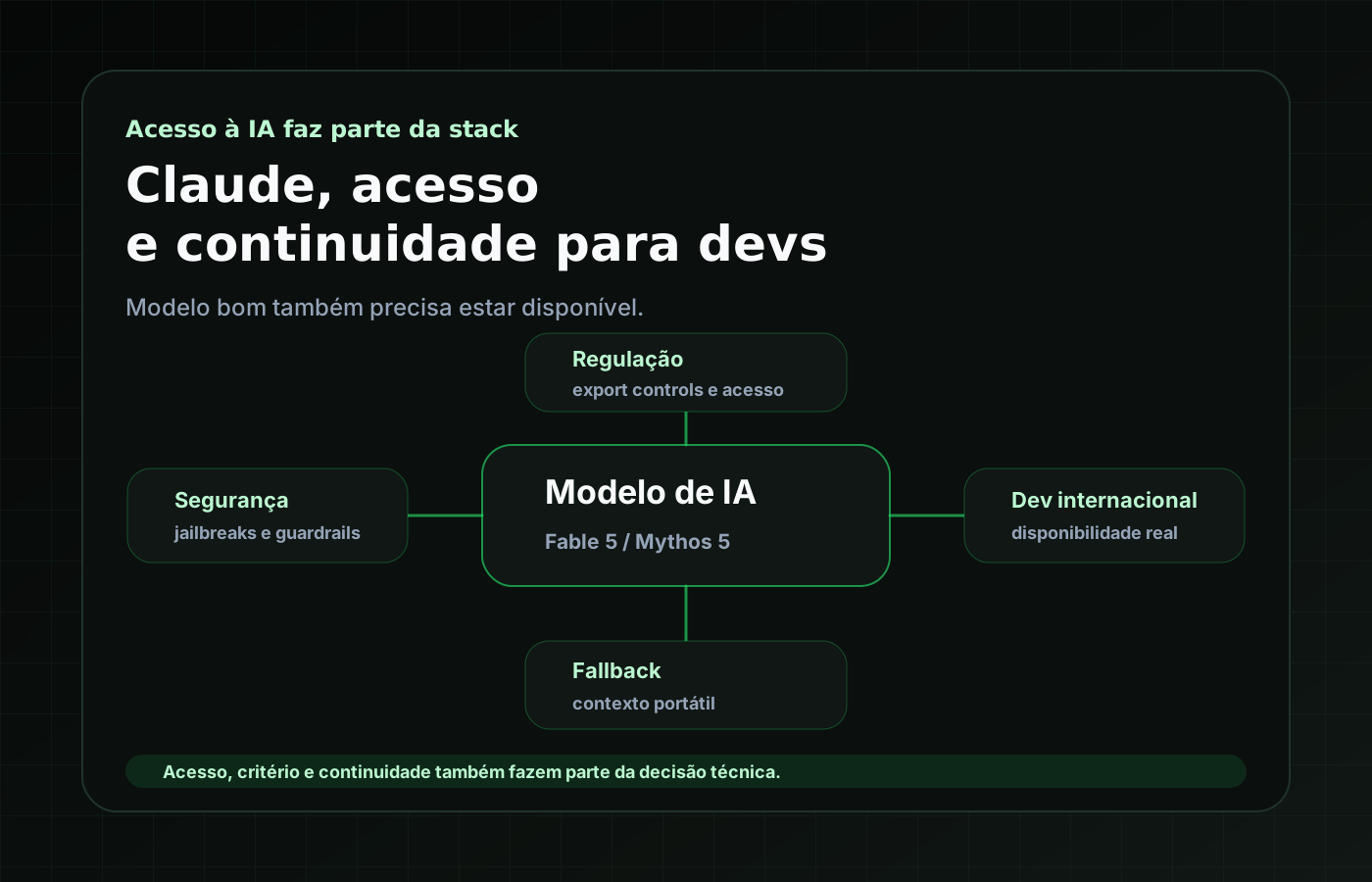
All of that still matters. But the Claude case adds another layer: availability. A model can be excellent in benchmarks, very good at coding, and still stop being a real option because of an access change, regional restriction, vendor rule, cost, compliance, or government decision.
For someone who uses AI only occasionally, this may be an inconvenience. For someone who has embedded AI into the workflow, it becomes an operational risk.
- a plan may change price;
- an API may change limits;
- a model may be discontinued;
- a company may change terms of use;
- an integration may break;
- an internal policy may restrict data usage.
In the end, the question is the same: how much of your process depends on one specific tool?
A practical example
Imagine two workflows. In the first one, everything lives inside the chat: project context, technical decisions, important prompts, acceptance criteria, validation commands, and the history of why something was done.
If the tool changes, part of the process disappears with it. In the second workflow, AI is still important, but the context lives outside it: the spec is in the repository, requirements are documented, key decisions are recorded, and the diff goes through human review.
In that case, switching models still has a cost. But it does not dismantle the work. The goal is not to abandon powerful tools. It is to avoid making the whole method depend on them.
A continuity checklist for using AI in development
- Access: is this model available to me, in my country, plan, and usage channel?
- Alternative: do I have another acceptable model for important tasks?
- Context: do specs, prompts, and decisions live outside the chat?
- Validation: can I review the output without blindly trusting the model?
- Integration: does my workflow depend on proprietary behavior?
- Continuity: does the work continue if price, rules, or limits change?
This checklist does not need to become bureaucracy. It is simply a lens to use before placing AI at the center of a process.
Lessons learned
- Access is also a technical characteristic.
- A good model needs to be available in the real usage context.
- Frontier models are getting closer to national security, governance, and regulation discussions.
- Specs, acceptance criteria, validation commands, and technical decisions need to survive model changes.
- Fallback is not pessimism. It is maturity when working with external platforms.
Limits and caveats
This article is not a legal analysis of export controls. It also does not recommend bypassing access restrictions, using VPNs, violating terms of use, or treating compliance as a detail. The lesson here is about process architecture, not about evading rules.
Another caveat: the title says Claude block because that is how many people are likely to search for the topic, but the specific case involves Fable 5 and Mythos 5. Other Claude models should not automatically be treated as part of the same restriction.
Finally, Fable 5 returning does not mean this kind of episode is over. It may be a sign of how more advanced models will operate from now on: with more evaluation, more limits, more agreements, and more dependence on regulatory context.
Conclusion
The Trump administration reversal in the Claude Fable 5 and Mythos 5 case should not be read only as political news.
For developers, the most useful message is technical: AI has become part of work infrastructure. And work infrastructure needs continuity, documentation, alternatives, and judgment.
Using the best available model makes sense. But the process cannot blindly depend on it. The model may return, change rules, or go offline. Context, validation, and technical responsibility need to remain with the developer.