
Claude Fable 5, Mythos 5, and Opus 4.8: what actually changes?
Understand the differences between Claude Fable 5, Mythos 5, and Opus 4.8 across capabilities, access, safeguards, costs, and practical use for developers.
Fable 5, Mythos 5, and Opus 4.8 differ not only in capability. The useful comparison involves access, safeguards, cost, and task fit.
Context
On May 28, 2026, Anthropic announced Claude Opus 4.8 as a premium model for coding, agents, and professional work, with a 1M-token context window and API pricing starting at US$ 5/MTok for input and US$ 25/MTok for output.
A few days later, on June 9, 2026, Claude Fable 5 and Claude Mythos 5 arrived.
The new names draw attention, but the most important part of the release is not only the idea of a "more powerful model". The more useful reading, especially for people using AI in development, is understanding how these models are positioned.
- Fable 5 brings Mythos-level capabilities to broader use, but with safeguards.
- Mythos 5 uses the same base as Fable 5, but remains restricted to approved partners because of sensitive capabilities.
- Opus 4.8 remains a strong premium option that is more accessible and available for general use.
Instead of asking only "which model is best?", it makes more sense to ask: which model fits this task, with this risk, this access level, and this cost?
Problem or question
The AI market is becoming harder and harder to follow. New models appear in sequence, names change quickly, benchmarks get a lot of attention, and there is always a feeling that a stronger version is available to test.
For people who build software or use AI to study, review code, organize ideas, and create digital products, that generic comparison does not help much.
The real problem is not finding which model scored more points on a chart. The problem is deciding, in practice:
- when the more expensive model is worth using;
- when a more accessible model is already enough;
- when access to the model is not available at all;
- when safeguards change the expected behavior;
- when a task justifies more context, more reasoning, and more cost.
That is why the question behind this post is direct: what changes between Claude Fable 5, Mythos 5, and Opus 4.8 when looking at capabilities, access, and cost?
Process analyzed
This article is based on Anthropic official documentation. It is not a personal benchmark and does not claim practical experience with Fable 5 or Mythos 5.
The comparison that matters here has four layers: capability, access, safeguards, and cost.
1. Capability
Anthropic presents Fable 5 as its most capable generally available model, aimed at ambitious, long-running, asynchronous tasks.
- agents that can work for longer;
- more complex coding tasks;
- large migrations;
- long implementations;
- vision work;
- analysis of documents, tables, diagrams, and PDFs;
- execution with more planning and self-checking.
Mythos 5 is described as Anthropic's most capable model for cybersecurity and biology research. The Mythos page itself says Fable 5 is the same underlying model, but with robust safeguards for cybersecurity and biology.
Opus 4.8 remains a strong premium model for coding, agents, professional tasks, and long workflows. The difference is that it occupies a more pragmatic position: it is not the newly released top of the Fable/Mythos line, but it has lower cost and broader availability.
2. Access
Fable 5 is available for broader use in the Claude Platform, compatible marketplaces and clouds, and applicable consumption-based enterprise plans.
Mythos 5 should not be treated as a regular off-the-shelf model. Anthropic says it is available only to a small set of approved partners, especially in trusted access programs related to cybersecurity and, later, biology.
Opus 4.8 is available to Pro, Max, Team, and Enterprise users, as well as through the API and compatible cloud platforms.
In practice: Fable 5 is the new advanced model that is more likely to be a real option for more people. Mythos 5 is a more restricted piece. Opus 4.8 remains the more accessible premium model for broad use.
3. Safeguards
This may be the most important difference between Fable 5 and Mythos 5.
According to Anthropic, Fable 5 includes safeguards for areas such as cybersecurity and biology. When a request is flagged in those domains, it may be refused or routed to Opus 4.8.
Mythos 5 exists for cases where more sensitive capabilities need to be used by vetted partners in controlled contexts.
That means Fable 5 and Mythos 5 should not be read as "two completely different models" in the common sense. Based on what Anthropic published, the central difference is access, use context, and safety layers.
4. Cost
In API pricing, the difference is simple.
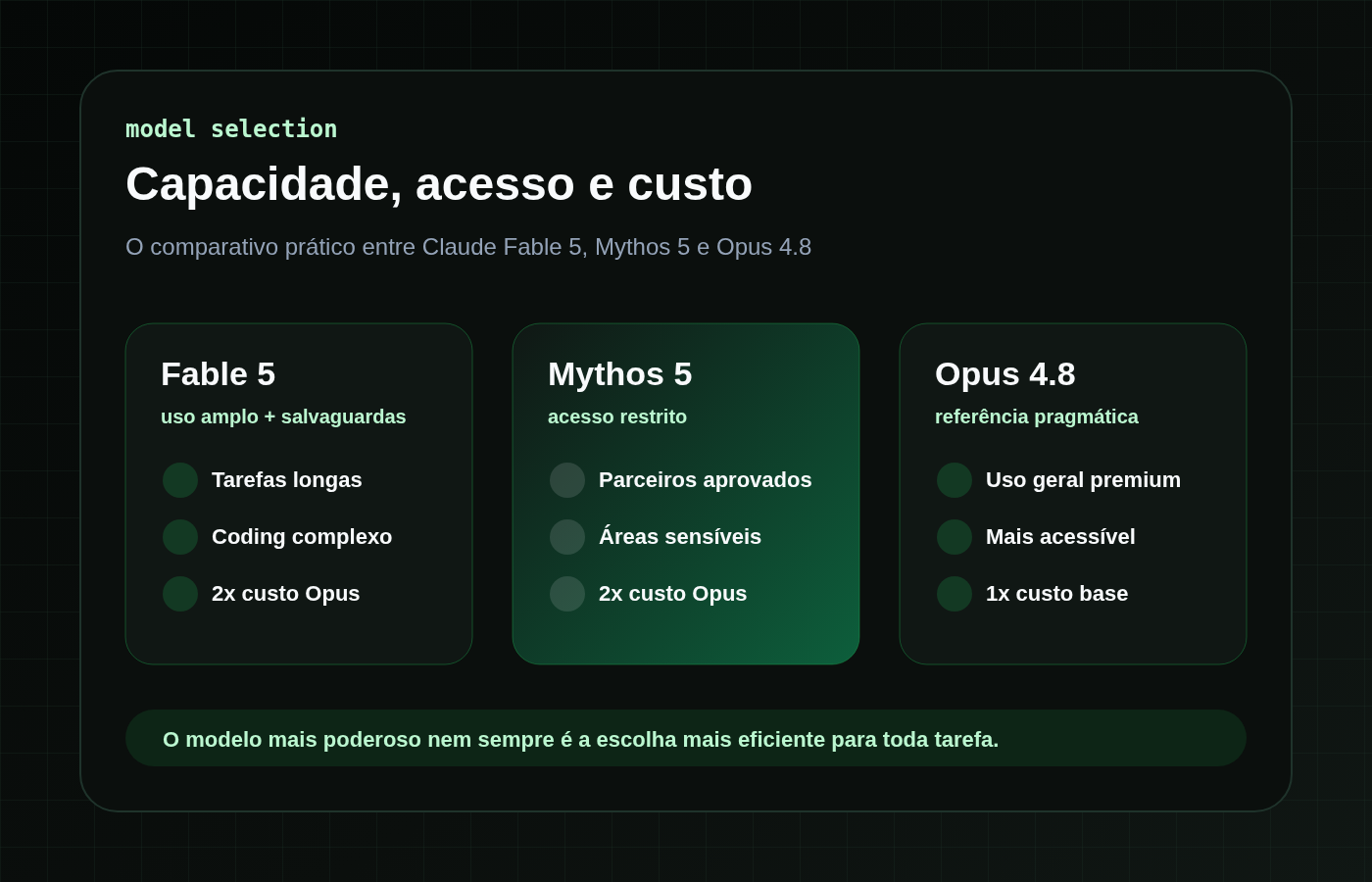
- Fable 5 and Mythos 5 cost US$ 10/MTok for input and US$ 50/MTok for output.
- Opus 4.8 costs US$ 5/MTok for input and US$ 25/MTok for output.
- In simple terms, Fable/Mythos cost twice as much as Opus 4.8 per token in the API.
That does not mean Fable 5 is "not worth it". It means the task needs to justify the cost.
If the work involves a long, complex, high-value task with multiple steps, testing the more capable model may make sense. But for a simple review, a focused explanation, a small adjustment, or a short task, the extra cost may not bring proportional gain.
Practical example
Imagine three types of development tasks.
Small task
You want to review a component, improve a function, explain an error, or adjust technical copy.
In this case, Opus 4.8 is probably already more than enough. Depending on the task, even a cheaper model may solve it.
Using Fable 5 for everything can be like bringing a heavy structure to a simple request. It works, but it may not be an efficient decision.
Long and ambitious task
Now imagine a larger migration, an architecture audit, a review of patterns spread across a codebase, or an implementation that requires several steps, interface checks, file reading, and sustained reasoning.
Here Fable 5 starts to make more sense. Its positioning is exactly that: long-running, asynchronous tasks with more autonomy, planning, and validation.
Even then, I would not treat it as an automatic choice. The test would need to compare quality, number of interactions, cost, and ease of reviewing the result.
Sensitive task
If the task enters advanced cybersecurity, biology, or areas with dual-use potential, the comparison changes.
Mythos 5 is not available for general use. Fable 5 has safeguards. Flagged requests may be routed to Opus 4.8 or blocked.
In that case, the difference is not only technical. It is also about access policy, safety, and governance.
Quick comparison
- Claude Fable 5: long tasks, agents, complex coding, and advanced knowledge work; broader access; safeguards in sensitive areas; US$ 10/MTok input and US$ 50/MTok output.
- Claude Mythos 5: cybersecurity, biology, health, and controlled research; restricted access for approved partners; less restrictive in those domains; starting at US$ 10/MTok input and US$ 50/MTok output.
- Claude Opus 4.8: coding, agents, and general professional work; broad access; standard safety policy; US$ 5/MTok input and US$ 25/MTok output.
What changes for developers
To me, the main shift is that model choice stops being only a comparison of "intelligence" and becomes a workflow decision.
1. Not every task needs the most expensive model
If the task is small, well defined, and easy to review, the most expensive model may be wasteful. The technical decision should consider cost, review time, and output value.
2. Stronger models need better tasks
Fable 5 looks more interesting when the problem is large enough to benefit from planning, long context, checking, and autonomy.
- goal;
- boundaries;
- relevant files or areas;
- acceptance criteria;
- response format;
- what should not be changed;
- how to validate the result.
More capability without clear scope only increases the chance of a sophisticated answer that is hard to review.
3. Access is also part of the product
There is no point in looking only at benchmarks if the model is restricted. For most developers, Mythos 5 is more important as a signal of Anthropic direction than as an immediate practical tool.
It shows that the company is separating sensitive capabilities into controlled programs, while Fable 5 tries to bring part of that capability to broader use with safeguards.
4. Cost needs to be part of the technical decision
Fable 5 costing twice as much as Opus 4.8 per token is not a detail.
For small tasks, it may not weigh much. For long tasks, with large context, tools, iterations, and extensive output, the difference can grow quickly.
- how many interactions were needed;
- how much context was used;
- how much of the response became real action;
- how much time was spent reviewing;
- how many errors were avoided;
- whether the additional cost was justified.
How I would test it
If I had access to Fable 5, I would run a controlled test against Opus 4.8. I would not start with a huge task. I would choose something real, but reviewable.
- map duplications in components;
- review documentation inconsistencies;
- plan a small migration;
- look for potentially dead files;
- compare two implementation approaches;
- review a feature before opening a PR.
The goal would not be to declare a universal winner. The goal would be to understand in which type of task the higher cost of Fable 5 starts to pay off.
Lessons learned
- Fable 5, Mythos 5, and Opus 4.8 should not be compared only by capability.
- Fable 5 and Mythos 5 share the same base disclosed by Anthropic, but differ in safeguards and access.
- Mythos 5 is not a general-use option; it is restricted to approved partners.
- Opus 4.8 remains relevant because it costs half as much as Fable/Mythos in the API and is more broadly available.
- More expensive models make more sense when the task is long, complex, and reviewable.
- Model choice should consider cost, risk, access, scope, and validation.
Limits and caveats
This article is an analysis based on official documentation and product positioning. It should not be presented as a personal benchmark.
It also should not claim that Fable 5 always outperforms Opus 4.8 in every task. The idea of "best model" depends on the type of use.
Another important point: Mythos 5 should not be treated as a tool available to any user. It appears in the comparison because it helps explain Anthropic strategy, but the practical decision for most people will probably be between Opus 4.8, Fable 5, and other models available through plans or API.
Finally, prices and access conditions can change. Before publishing or using this comparison for a real decision, it is worth checking the official pricing page and model pages again.
Conclusion
The launch of Fable 5 and Mythos 5 leaves an interesting message: model competition is not only about raw capability.
In real use, especially in development, the decision goes through four questions:
- Does the task justify a more expensive model?
- Is the model available for my use case?
- Do the safeguards affect the type of task I want to run?
- Will the result be reviewable, testable, and useful?
Fable 5 points toward longer, more ambitious, more agentic work. Mythos 5 shows a more restricted layer for sensitive capabilities. Opus 4.8 remains a more pragmatic premium choice for many things.
To me, that is the point: the most powerful model is not always the best choice. The best choice is the model that solves the task with the right level of capability, cost, and control.