
Trump, Claude 5, and AI restrictions: what changes for developers
The Fable 5 and Mythos 5 case shows how regulation, access, and vendor dependency can affect AI development workflows.
Fable 5 and Mythos 5 were available for only a few days before a US government order took both models offline for everyone. For developers, the case shows that access, portability, and continuity are also part of the technical decision.
Update note
This article was rewritten on June 23, 2026, and fact-checked again before publication on June 24, 2026.
Anthropic's public statement still says that Fable 5 and Mythos 5 were suspended. The official Mythos page also says access remains unavailable to Project Glasswing partners.
At the same time, the political situation changed after the first draft. On June 17, Donald Trump said negotiations with Anthropic were “going fine.” Two days later, he told Axios that he no longer viewed the company as a threat at that moment and that teams were working on standards for evaluating jailbreaks.
On June 24, the Associated Press published another important detail: according to an unnamed US official, Mythos found vulnerabilities in sensitive government systems during a controlled test with intelligence agencies. The source stressed that finding vulnerabilities did not mean the model had exploited them within that time.
This supports the view that there were genuine concerns about cyber capabilities, but it does not by itself explain whether the order was proportionate or why it was so broad. As of this review, I could not find the full directive or official confirmation that access had been restored.
Context
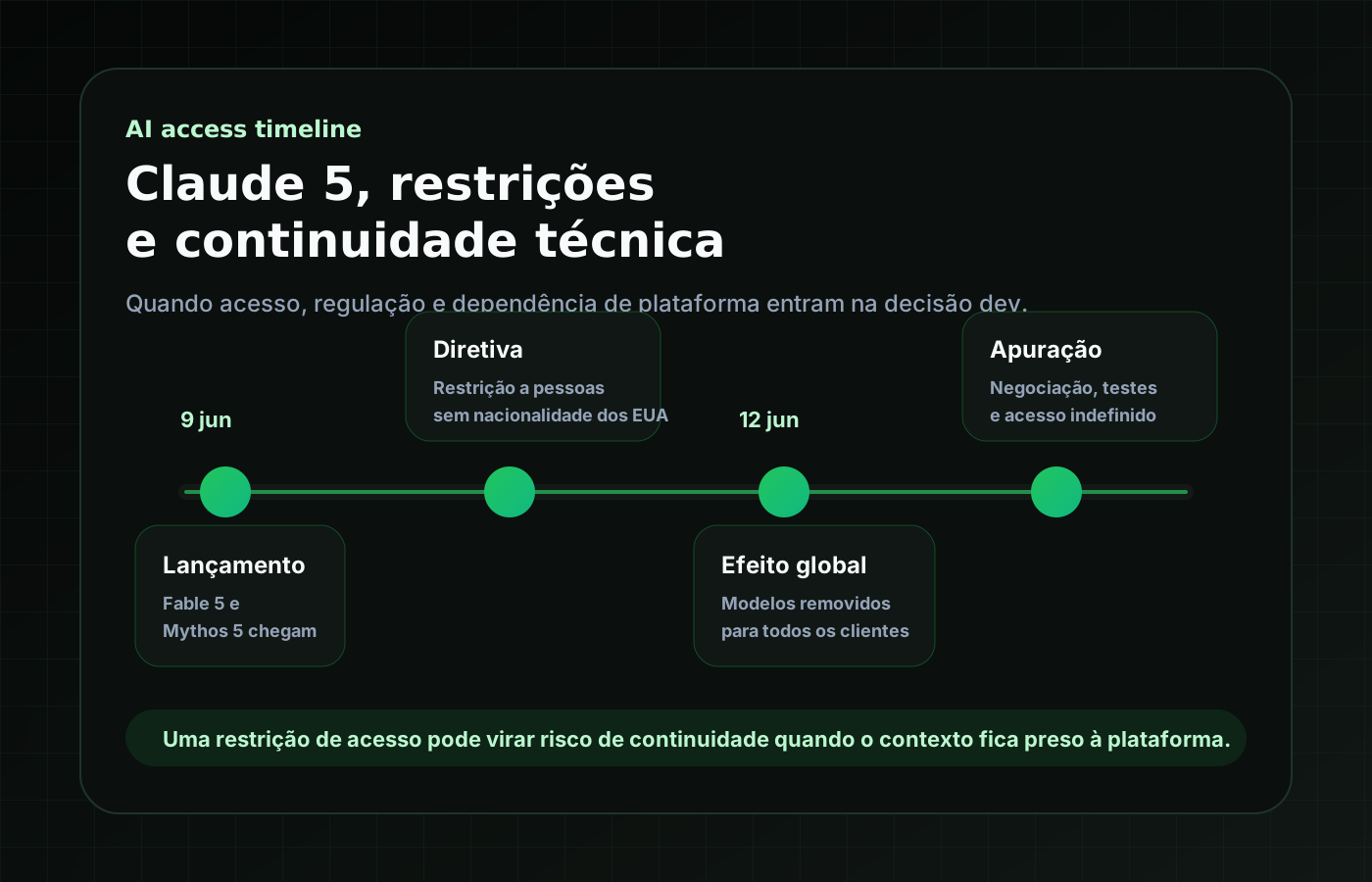
On June 9, 2026, Anthropic launched Claude Fable 5 and Claude Mythos 5.
Fable 5 was intended for broader use, with safeguards that redirected some sensitive requests to Opus 4.8. Mythos 5 used the same underlying model but offered less restricted capabilities to a controlled group of partners, mainly in cybersecurity and research.
Three days later, both models went offline.
According to Anthropic, the US government issued an export-control directive prohibiting access by any foreign national, whether inside or outside the United States, including Anthropic's own foreign-national employees.
The order did not simply say “turn off Claude.” It applied to two specific models and, according to Axios, required licenses for exports, reexports, or domestic transfers to foreign persons.
The practical effect was broader: Anthropic removed Fable 5 and Mythos 5 for every customer. Other Claude models remained available.
That distinction matters. This was not a complete Claude shutdown or a general ban on AI for people outside the United States. It was an intervention targeting specific models, driven by national-security concerns and a reported jailbreak that could bypass cybersecurity safeguards.
What changed after the initial reports
The first draft of this article treated the dispute as a newly developing event. A week later, the picture is somewhat clearer, but the case is not resolved.
Donald Trump said on June 17 that negotiations with Anthropic were “going fine.” In an Axios interview published on June 19, he said he no longer viewed the company as a threat at that moment and praised CEO Dario Amodei's response.
According to the same report, technical teams began discussing standards for evaluating jailbreaks. Anthropic said it was continuing to work with the government to resolve the situation.
Improved relations, however, do not mean access has been restored.
As of June 24, Anthropic's official pages still listed Fable 5 and Mythos 5 as unavailable. There was also no public document explaining all the technical evidence used by the government, the criteria for restoring the models, or the expected timeline.
On the same day, the Associated Press reported that Mythos had identified vulnerabilities in sensitive government systems during a test. The report helps put the model's capabilities in perspective, but it should not be presented as proof that the model exploited or breached those systems.
The most responsible reading today is:
- the order and the global removal of the models are confirmed;
- relations between the government and Anthropic have publicly improved;
- negotiations and technical work are ongoing;
- access has not been officially restored;
- the regulatory outcome remains open.
The practical question for developers using AI
Models are usually compared by benchmarks, reasoning, cost, context windows, and code quality.
All of those criteria still matter. The Fable 5 and Mythos 5 case adds another one: continuity.
A model can be technically excellent and stop being a practical option because of a pricing change, plan restriction, internal policy, regional availability, or government decision.
The question is no longer only “which model is better?” It also becomes: “will my workflow keep working if this model becomes unavailable tomorrow?”
A practical example
Imagine a developer whose entire workflow depends on one tool:
- planning lives inside the chat;
- technical decisions are trapped in conversation history;
- prompts rely on one model's specific behavior;
- acceptance criteria are undocumented;
- no alternative has been tested.
When access changes, that developer does not lose only an AI model. They lose context, process, and predictability.
Now compare that with a workflow where:
- the spec lives in the repository;
- requirements and constraints are documented;
- important prompts can be reused;
- technical decisions are recorded;
- builds, tests, and diff reviews remain independent from the model;
- at least one alternative is known for critical tasks.
Switching tools still takes time. It does not stop the work completely.
Four lessons for developers
1. Access is also a technical characteristic
A benchmark is not useful when the model is unavailable in your country, plan, company, or delivery channel.
Availability belongs in the comparison alongside quality, price, latency, and context windows.
2. Frontier models have become strategic infrastructure
Advanced models now support software development, security, science, automation, and business operations. As their capabilities grow, so does the attention from governments and regulators.
That does not make every AI use case a national-security issue. It does mean the most capable tools may be subject to rules that do not apply to ordinary software products.
3. Portable context reduces dependency
The answer is not necessarily to abandon hosted platforms or use only local models. It is to avoid placing the entire process inside one vendor.
Goals, scope, acceptance criteria, decisions, validation commands, and sources should remain accessible outside the chat. The more portable the context, the lower the cost of switching models.
4. The model may change; technical judgment should not
No alternative removes the need for human review, tests, diff inspection, source checking, and careful handling of sensitive data.
Portability is not just sending the same prompt to another AI. It is keeping the work correct when the tool changes.
Continuity checklist
- Access: is the model available in my country, plan, and delivery channel?
- Alternative: do I have another acceptable model for important tasks?
- Context: are specs and important decisions stored outside the chat?
- Validation: can I review the output without blindly trusting the model?
- Integration: does my workflow depend on a proprietary API or behavior?
- Continuity: will the work continue if pricing, plans, or rules change?
Limits and caveats
This article is not legal analysis and does not conclude whether the directive was proportionate or technically justified.
The jailbreak explanation was reported by Anthropic and sources speaking to the press. The AP also published an unnamed official's account of Mythos finding vulnerabilities during a government test, while making clear that finding did not equal exploitation. Without the complete directive and technical materials, the government's full reasoning cannot be independently assessed.
It is also inaccurate to say that all of Claude was blocked. The measure affected Fable 5 and Mythos 5; other models remained available.
Finally, this article does not recommend bypassing restrictions, terms of service, or access controls. The lesson is about continuity and process architecture, not evading rules.
Conclusion
The Fable 5 and Mythos 5 case shows that an AI tool depends on more than model quality.
It depends on a company, infrastructure, contracts, access rules, and sometimes political decisions made with limited public transparency.
For developers using AI, the answer does not have to be panic or abandoning a specific tool. It should be operational maturity.
Use strong models when they help, keep context and decisions outside the platform, validate the work, and understand the alternatives.
The model may return, change, or go offline. The process should remain in our hands.