
GPT-6 Astra: where does it really outperform Sol, Terra, and Luna?
Learn where GPT-6 Astra advances, its limits, pricing, and how it compares with GPT-5.6 Sol, Terra, and Luna for development and agent workflows.
GPT-6 Astra raises the ceiling for complex end-to-end work. That does not make it the best choice for every task: a mature decision compares the cost of reaching an approved result.
More capable does not automatically mean more suitable
When a new model arrives, the conversation usually jumps straight to intelligence and benchmarks. Both matter, but they leave out the question that matters to people building AI products: for which task does the extra capability create enough value to justify its cost?
OpenAI positions GPT-6 Astra as its most capable model for difficult end-to-end work. Highlights include complex reasoning, coding, research, computer use, and document creation. Its most interesting advantage is less about size and more about how the model coordinates a long workflow.
1Surface-level question:2Which model has the highest benchmark?34Useful question:5Which model completes this task at acceptable quality and the lowest total cost?What is GPT-6 Astra?
In the API, the documented identifier is `gpt-6-astra`. The model accepts text and images as input, produces text, and supports streaming, function calling, and Structured Outputs. In the Responses API, the documentation lists web search, file search, image generation, code interpreter, hosted shell, apply patch, skills, computer use, MCP, and tool search.
The context window is 1,050,000 tokens, maximum output is 128,000 tokens, and the stated knowledge cutoff is April 30, 2026. Reasoning levels are `low`, `medium`, `high`, `xhigh`, and `max`; there is no `none` option. The model page also says fine-tuning is not available.
Where Astra gains an advantage
1. Truly end-to-end workflows
Astra was designed for work where reasoning and execution are connected: reading a spec, finding project rules, changing code, consulting documentation, opening an interface, verifying the result, and producing a final artifact. The expected gain is keeping the objective and constraints coherent across those stages.
2. Asynchronous tool calls
With async tool calling, the model can continue reasoning, start another tool, or answer an independent part while a custom call is still running. The application remains responsible for executing the tool and returning the result associated with its `call_id`.
The potential gain is not merely a faster answer. It is reducing idle time in workflows with independent stages without losing coordination of the final result.
3. Course correction during execution
Mid-turn steering lets a user send a new instruction while Astra is still working. In a WebSocket connection to the Responses API, completed work can be preserved and the correction becomes part of the continuation. This helps when a rule was misunderstood, scope changed, or a verification revealed a new requirement.
4. Adjustable reasoning within a conversation
A `configuration_update` item can increase or reduce reasoning effort without rewriting the original prefix. This makes it possible to reserve more compute for an impasse and return to a lower level for predictable stages, preserving cache benefits when the configuration is compatible.
1simple triage -> low2architecture decision -> high3routine verification -> low4difficult impasse -> xhigh or max5. Coherence, instructions, and visual judgment
The official guide says Astra maintains better coherence than GPT-5.6 Sol and earlier models in long tasks. It also highlights stronger instruction following, more care around boundaries, and greater capability in workflows that depend on screenshots, visual comparison, or computer use.
For web development, this can bring verification closer to the real experience: valid code does not guarantee a correct interface, a passing build does not guarantee good mobile readability, and a created file does not guarantee a well-laid-out document. These are still benefits reported by OpenAI; each team needs to test them in its own workflow.
What did not change
- Astra, Sol, Terra, and Luna state the same 1.05-million-token context window.
- All four also state the same 128,000-token maximum output.
- More capability does not remove the need for evals, observability, fallback, security, or human review.
- Models remain nondeterministic: one good run does not prove consistency.
Direct comparison: Astra, Sol, Terra, and Luna
The figures below are API prices per 1 million tokens, checked against the official documentation on September 7, 2026. API pricing, message limits, and plan credits are different measures and should not be mixed.
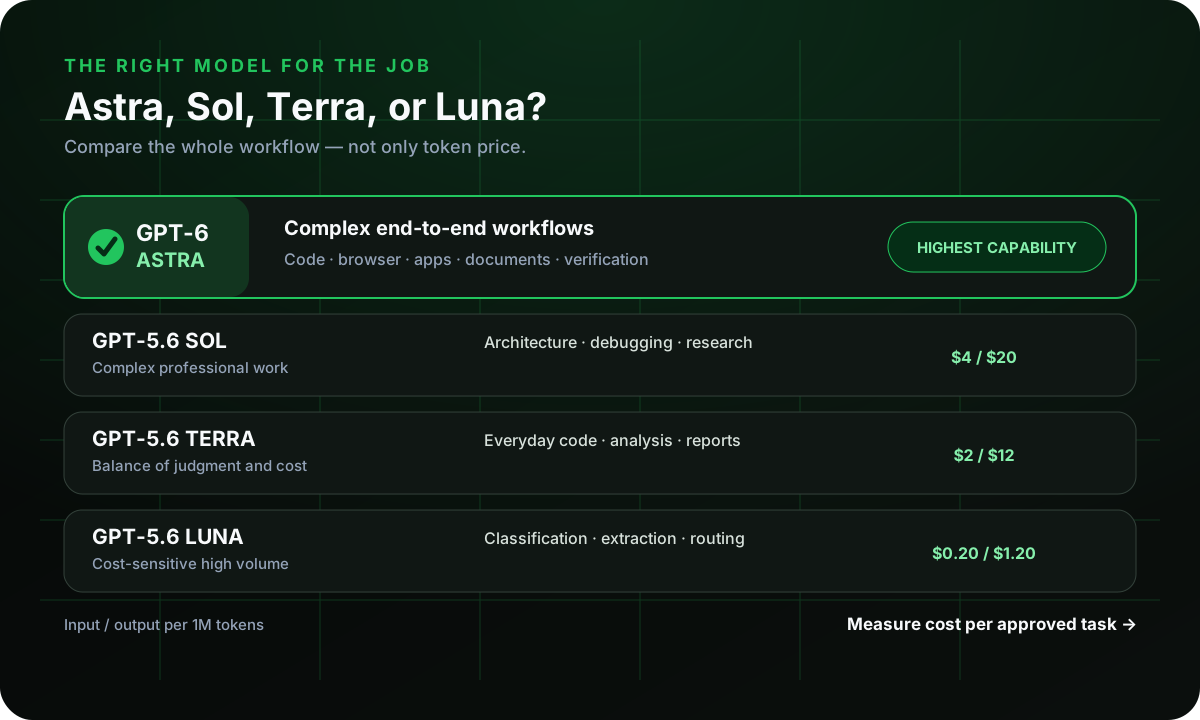
1MODEL INPUT CACHE OUTPUT CONTEXT MAX OUTPUT2GPT-6 Astra $10 $1 $50 1.05M 128K3GPT-5.6 Sol $4 $0.40 $20 1.05M 128K4GPT-5.6 Terra $2 $0.20 $12 1.05M 128K5GPT-5.6 Luna $0.20 $0.02 $1.20 1.05M 128KAstra costs 2.5 times as much as Sol for both input and output tokens. Because context and output ceilings are equal, Astra is a bet on judgment, tool coordination, and workflow completion. Prompts above 272,000 input tokens receive multipliers for the entire request: 2x for input and cache, and 1.5x for output.
GPT-6 Astra
I would start with Astra for work involving dependent stages, slow tools, changes during execution, visual verification, or a high cost of rework. It needs to justify its price by reducing failures, attempts, or supervision.
GPT-5.6 Sol
Sol remains a strong reference for architecture reviews, difficult debugging, advanced coding, research, and complex professional deliverables. At 40% of Astra's per-token price, it is an important baseline before escalating.
GPT-5.6 Terra
Terra offers the most defensible balance for frequent tasks that still require judgment: reports, document analysis, everyday coding, automations, and intermediate stages in a larger workflow.
GPT-5.6 Luna
Luna is the natural choice for cost-sensitive high volume: classification, structured extraction, routing, triage, and narrow operations with a clear schema. It does not need to solve the entire workflow; it can route only ambiguous cases to larger models.
Token price and task cost are not the same thing
OpenAI says Astra achieved better results with fewer output tokens in several evaluations and connects that result to a lower estimated cost per task. This is a vendor claim, not a guarantee for every application.
Token price measures the cost of processing an amount of text. Task cost measures what it took to reach an accepted result, including all attempts, tools, elapsed time, human intervention, review, and defects found afterward.
A cheaper model can become expensive if it needs four attempts. An expensive model remains expensive if the task was simple and the extra capability did not change the result.
An example: from requirement to validation
1Read the spec and project rules.2Implement a responsive section with existing components.3Run the build and open the page in the browser.4Compare the result with the visual reference.5Fix the issues you find.6Report changed files, validations, and limitations.This task combines reading, technical decisions, code, commands, browser work, visual judgment, and final communication. Luna can extract criteria; Terra can map files; Sol can implement and investigate complex issues; Astra can conduct the whole workflow and absorb corrections. The best division depends on the unit of work, not on the newest name.
How to compare them in your own workflow
I would avoid a contest built around a generic benchmark. I would use a representative task and repeat the same test with Astra, Sol, and Terra. Luna would take part in a focused stage. Prompt, files, tools, permissions, time limit, and acceptance criteria need to remain the same.
- Run more than one trial per model.
- Record the model, reasoning level, and processing configuration.
- Send a requirement change while the work is in progress.
- Measure passed criteria, tokens, cost, duration, and attempts.
- Count human interventions and errors found during review.
- Separate model failures, tool failures, and environment failures.
1which model delivers sufficient quality2for each type of task3at the lowest acceptable total cost?Limitations and caveats
This article uses official information revalidated on September 7, 2026. Pricing, features, and availability can change. Product access may also depend on the account, plan, and workspace settings, so the official page should be checked before a purchasing or architecture decision.
I did not run my own benchmark across the four models for this article. Claims about greater capability, coherence, and efficiency come from OpenAI documentation. They need to be tested with representative evals before guiding a production architecture.
- Astra does not offer `none` reasoning and does not support fine-tuning.
- Text and images are native inputs; audio and video are not.
- Using the entire context window can substantially increase cost.
- More capability does not replace autonomy limits and human approval for sensitive actions.
Conclusion
GPT-6 Astra expands what an agent can attempt to complete in a single workflow. Asynchronous tools, corrections during execution, adjustable reasoning, and greater coherence make it especially interesting for work spanning code, browsers, applications, and documents.
The choice still needs to make economic sense. Luna can handle high-volume classification and extraction. Terra offers balance for everyday work. Sol remains a reference for complex professional work. Astra earns its place when the hard part is keeping the entire workflow under control.
Did the extra capability reduce attempts, rework, and supervision enough to pay for the difference? That answer, measured in the real context, is what turns novelty into a technical decision.