
Practical guide to observability, cost, and fallback in AI apps
Learn which logs, metrics, cost limits, retries, and fallbacks help operate AI features beyond manual testing.
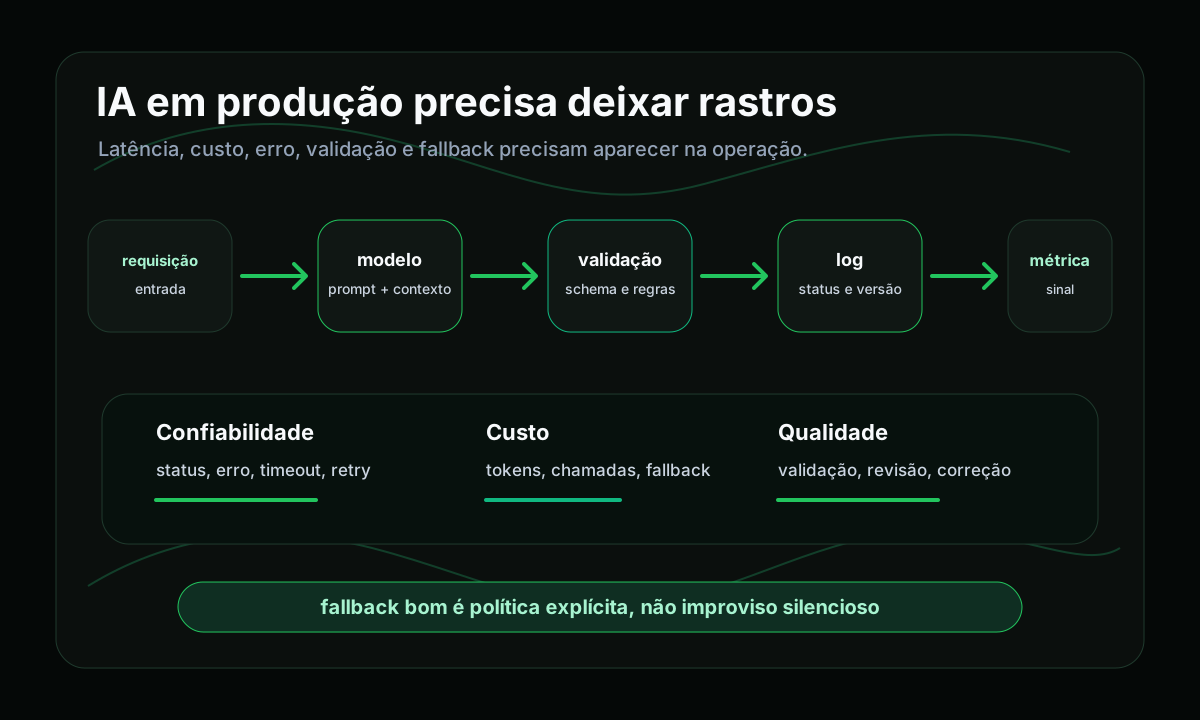
Calling an AI API is only the beginning. Once the feature enters a real flow, latency, cost, errors, validation, fallback, and quality signals also need to be tracked.
Context
In the latest guides in this series, the conversation moved closer to engineering: RAG for retrieving context, structured outputs for turning responses into data, evals for measuring behavior, harnesses for repeating tests, agents with tools for consulting or acting, and personal agents for thinking about autonomy, memory, and channels.
Now comes a less flashy but very important part: how do you track all of this once the feature is running?
An AI feature can look great in manual testing and still fail in subtle ways during real usage. It can become slow, cost more than expected, fail validation, trigger fallback constantly, or return HTTP 200 with an output that is bad for the system.
The problem
In a traditional integration, many errors appear directly: an API returns 500, a call times out, or a required field is empty. With AI, that still exists, but other kinds of problems appear too.
- The model can respond in time but ignore an important rule.
- It can return JSON that is almost right, but invalid.
- It can consume many tokens in a case that looked simple.
- It can need a retry and double the cost of that execution.
- It can trigger fallback and hide that the main flow is failing.
Without records, all of this becomes a feeling: "I think it got slower", "it seems to be costing more", "some answers got worse". Without minimum observability, investigating an AI feature becomes a mix of guesses, screenshots, and recent memory.
Mental model
A simple way to think about observability for AI apps is to separate three layers: reliability, cost, and quality.
1reliability2 -> did the call work?34cost5 -> how much did this execution consume?67quality8 -> was the response useful and valid for the flow?These three layers need to talk to each other. It is not enough to look only at technical errors if the response passes through the API but fails the schema. It is not enough to look only at tokens if the cheap answer is poor. And triggering fallback is not enough if no one records when it happened, why it happened, and what the result was.
Minimum logs
Logging does not mean storing everything. In AI apps, this is especially important because prompts, context, and responses can contain sensitive data. The first rule is not to record more than you need to operate and investigate the flow.
1{2 "feature": "summary",3 "model": "model-name",4 "promptVersion": "summary-v3",5 "status": "fallback_used",6 "latencyMs": 1840,7 "inputTokens": 920,8 "outputTokens": 260,9 "estimatedCost": 0.0042,10 "validation": "passed"11}This example is fictional, but it shows the idea. With a few fields, you can already investigate which feature ran, which model answered, which prompt version was active, how long it took, how many tokens were used, whether validation passed, and whether fallback was triggered.
A good log helps investigation without becoming a leak waiting to happen.
Important metrics
Logs help investigate specific events. Metrics help reveal aggregate behavior. In an AI feature, a few simple metrics already help a lot.
- Average and P95 latency to understand real slowness.
- Error rate to track technical failures.
- Validation failure rate to separate an API response from a useful response.
- Fallback usage to know whether plan B became the main path.
- Tokens per execution and estimated cost per flow.
- Retries per execution to identify duplicated cost or waiting time.
- Human correction or review to create a minimum quality signal.
If a prompt change reduced schema errors but doubled tokens, that needs to show up. If a new model improved quality but increased latency in a bad way for the experience, that also needs to be part of the decision.
Quality also needs a signal
A common trap is treating observability only as technical monitoring. Response time, errors, timeouts, and cost are fundamental, but in AI there is an additional question: was the response good for what the system needed to do?
- Did the response pass the schema?
- Did the classification match what was expected?
- Did the user accept the suggestion?
- Did the user edit the response heavily?
- Did a reviewer mark the output as correct, partial, or poor?
- Did a known eval pass or fail?
- Was fallback triggered by low confidence, error, or timeout?
Quality, in this context, is less about an absolute score and more about consistent signals. The system does not need to pretend it can measure everything, but it needs to make clear what it is observing.
Retry, timeout, and fallback
Retry and fallback look like simple decisions. In practice, they require care. Retry can help with temporary errors, network instability, or occasional timeouts, but it can also make the experience worse if the problem is a poor prompt, an input that is too large, or an unstable provider.
Fallback also needs a rule. Does it trigger because of error, timeout, cost, validation, or low quality? Which model, flow, or alternative response does it use? Does the user need to know? Does the result go through the same validation? Is there a limit to avoid duplicated cost?
A good fallback is not only "if it fails, try another one". It is an explicit policy.
HTTP 200 is not enough
In AI apps, technical success does not mean functional success. The API can respond successfully and the feature can still fail.
- The JSON was invalid.
- A required field was empty.
- The model ignored an instruction.
- The summary was too long.
- The classification was outside the allowed options.
- The response used the wrong context.
- The user had to rewrite almost everything.
1api_success2validation_failed3fallback_used4human_review_required5user_corrected6completedThese states help reveal the real flow. If everything becomes only "success" or "error", a lot of important information disappears.
What not to log
Observability cannot become an excuse to store sensitive data without judgment. In many flows, the content sent to the model can include personal information, internal data, documents, messages, RAG-retrieved context, or responses that have not been reviewed yet.
- Do I really need to store this?
- For how long?
- Who can access it?
- Is there an anonymized form?
- Can I store only metadata?
- Would this truly help in an investigation?
The goal is to observe the system, not create a huge archive of sensitive content. The more autonomy the feature has, the more important this question becomes.
How to start simple
- Define the main statuses in the flow.
- Record model, prompt version, latency, tokens, and validation.
- Mark when retry or fallback happens.
- Separate technical errors from invalid responses.
- Create a simple view of estimated cost per feature.
- Periodically review cases with failures, fallback, or human correction.
- Use the learnings to improve prompt, schema, retrieval, or model.
That already changes the conversation. Instead of "I think it got worse", it becomes possible to say: "latency increased for long inputs, fallback increased after the last change, and validation failed more often in the category field".
Relationship with evals and harnesses
Evals, harnesses, and observability complement each other. Evals help define what to evaluate. A harness helps run cases repeatably before approving a change. Observability helps track behavior after the feature is running.
Before publishing a new prompt version, you can run a harness with representative cases. After publishing, observability can show that validation failures decreased, but latency increased for large inputs. Now there is a real decision: accept it, adjust it, create a specific fallback, or revert to the previous version.
When to keep it even simpler
Not every small experiment needs complete tracking from the beginning. If you are studying, prototyping, or testing a local idea, building a full structure for logs, metrics, and fallback may be too much.
But there is an important turning point: when the feature starts dealing with real users, important data, variable cost, automation, or decisions that affect the product flow, it stops being only an experiment.
Practical checklist
- Do I know which model answered?
- Do I know which prompt version was active?
- Can I measure response time?
- Can I estimate cost per call or per flow?
- Can I distinguish API errors, timeouts, and invalid responses?
- Do I validate the output before using it in the system?
- Do I know when retry and fallback happen?
- Does fallback have a limit?
- Do I avoid storing unnecessary sensitive data?
- Do I have any quality signal after real usage?
Conclusion
AI features do not fail only when the API goes down. They also fail when they respond too slowly, cost more than expected, return invalid output, trigger fallback without records, or look good as text but perform poorly in the system flow.
The beginning can be small: safe logs, basic metrics, output validation, fallback records, and review of problematic cases. This does not make AI perfect. But it takes the feature out of the dark.
AI in production also needs a dashboard, limits, and a plan B.