
What vibe coding means when technical responsibility still matters
Vibe coding can help developers explore ideas and create prototypes faster, but fast code generation only becomes useful when it goes through context, review, validation, and technical responsibility.
Vibe coding can speed up idea exploration, but fast code generation only becomes useful when it goes through context, review, and validation.
Context
Vibe coding has become one of those terms that appears often when the subject is AI in development.
In simple terms, the idea is related to programming with natural language, prompts, fast feedback, and AI tools that generate a large part of the implementation. Instead of writing every detail manually from the start, the person describes an intention, reviews the response, adjusts the request, and guides the tool toward a first version.
That can be very useful.
To start a screen from scratch, test an idea, build a navigable prototype, or understand a new approach, this kind of flow reduces a lot of the initial friction. AI helps turn a loose intention into something visible, clickable, or at least discussable.
But there is an important difference between generating a first version and having a finished solution.
That is where the topic becomes more interesting to me. Vibe coding does not need to mean carelessness. It also should not be sold as a magical way to create software without understanding software. The value is in the middle: using AI to explore faster without giving up responsibility for what enters the project.
Problem or question
The question behind this post is: how can vibe coding be used as productive experimentation without turning the process into careless improvisation?
The risk is not only that AI can generate something wrong. That would already be enough reason to review it.
The bigger risk is that it generates something plausible.
A piece of code can look good, compile, and even solve the apparent problem, while still not fitting the project. It can ignore existing components, create unnecessary abstraction, duplicate logic, break responsiveness, miss accessibility, or hide a technical decision that nobody reviewed.
When someone accepts that result too quickly, the problem is not the tool. The problem is confusing generation speed with decision quality.
That is why I see vibe coding more as an exploration stage than as a shortcut for skipping technical understanding.
Process tested
The path that makes the most sense to me starts before the prompt.
Even in a looser AI session, I try to separate a few points:
- What problem am I trying to solve?
- What is the project context?
- Which constraints need to be respected?
- What would count as an acceptable first version?
- How will I validate whether the answer makes sense?
These questions look simple, but they change the result a lot.
Asking "create a blog screen" is very different from explaining that the project uses Nuxt, Vue, TypeScript, Tailwind, reusable components, a dark theme, a specific editorial tone, and that it should not look like a commercial landing page.
The same applies to code.
Asking "build this component" is different from pointing out which components already exist, which props should be preserved, which style patterns are used, and which validations need to run afterward.
In this flow, AI works as support for speeding up the first proposal. It can suggest structure, generate a base, compare alternatives, or help organize next steps. But the answer still needs to go through review.
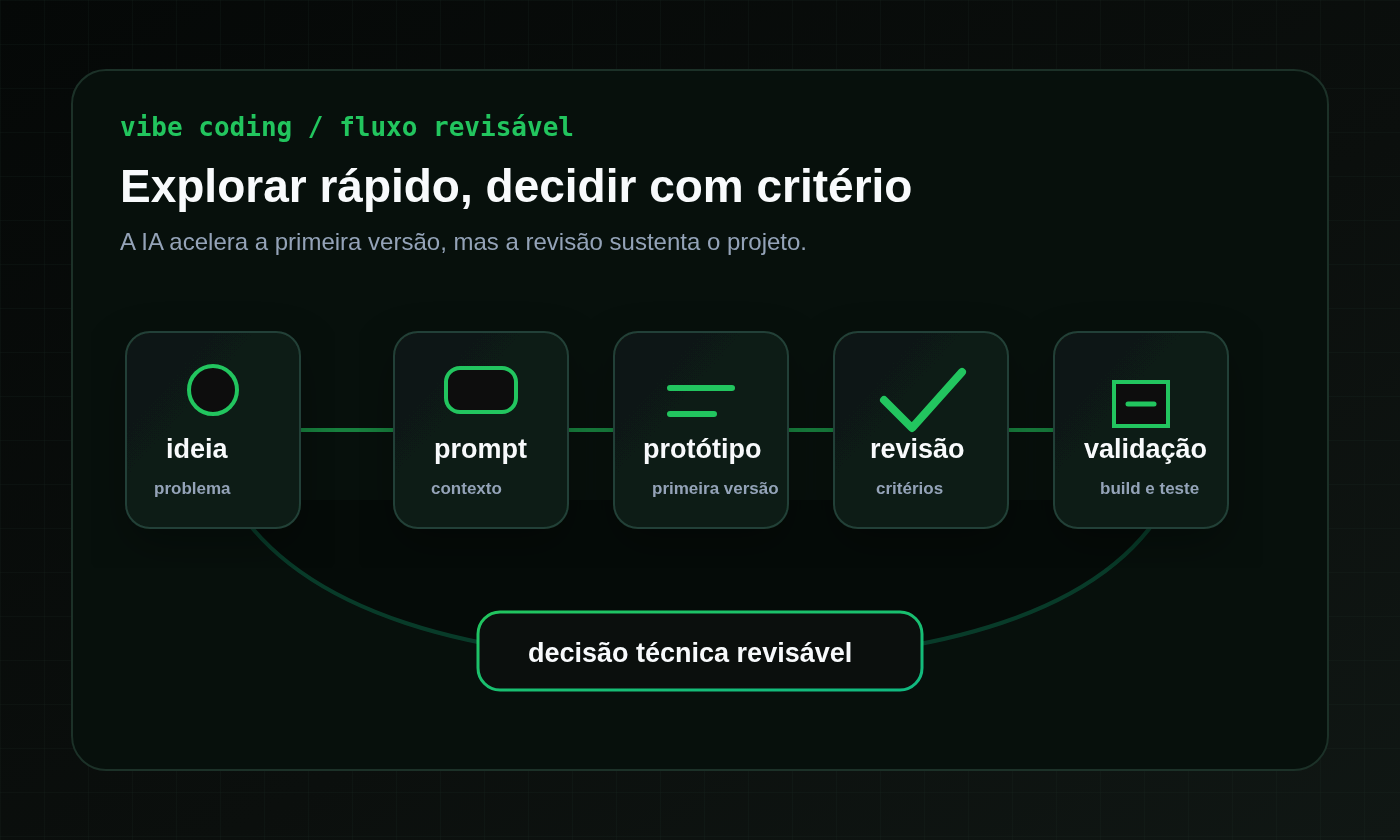
To me, a healthy vibe coding session has at least four moments:
- Organize the intention.
- Generate or iterate a first version.
- Review what was generated against the real project.
- Validate behavior, build, and maintainability before calling it ready.
Without that second half, the process becomes fragile.
Practical example
A simple example is turning a loose idea into a screen or section.
The rushed path would be to open the tool and ask: create a beautiful page about this topic.
Sometimes the answer looks visually interesting. But it may come with a tone that does not fit the project, classes outside the pattern, duplicated components, generic text, hard-to-maintain structure, or a solution larger than necessary.
A better path is to start with a small spec:
- the screen goal;
- the main audience;
- the information that needs to appear;
- existing components that should be reused;
- visual constraints;
- what stays out of scope;
- acceptance criteria.
After that, AI can generate a first proposal with much more direction.
Even then, the proposal should not be accepted automatically. I need to look at the result and ask:
- Does this solve the right problem?
- Does the solution respect the current structure?
- Does the code use existing patterns?
- Is the interface still responsive?
- Does the visual decision fit the rest of the site?
- Can I explain why this solution was chosen?
- Were the available validations executed?
That difference is small at the beginning, but big in the result.
Vibe coding with technical responsibility is not letting AI decide everything. It is using AI to speed up exploration and then treating review as part of the work.
Lessons learned
- Vibe coding helps more when there is context. The clearer the goal, the better the answer tends to be.
- A first version generated by AI should be treated as a proposal, not as a final delivery.
- Fast prototyping is useful, but production requires review, validation, and maintenance.
- A simple spec before the prompt reduces ambiguity and avoids generic answers.
- Code that works visually can still be misaligned with the project architecture.
- The developer remains responsible for understanding, adapting, and explaining the solution.
- Build, tests, visual review, and behavior checks remain part of the process.
- The best use of AI does not remove technical judgment. It makes technical judgment more important.
Limits and caveats
Not every task fits vibe coding.
For exploring a screen, testing an interaction, studying a library, or creating an initial prototype, the approach can work well. For critical changes, delicate business rules, security, sensitive data, complex integrations, or architectural decisions, the level of care needs to be much higher.
I also do not think it is useful to treat vibe coding as a fixed identity. In practice, there are different levels of AI use. Sometimes it helps write a small snippet. Sometimes it helps structure an entire page. Sometimes it is more useful for reviewing an idea than for generating code.
The main point is knowing which stage you are in.
If it is an experiment, it is fine to assume it will still change. If it is a prototype, it is fine to prioritize learning and speed. But if it will enter a project that needs to be maintained, the conversation changes. Then context, patterns, review, and validation come in.
Another important limit: AI can increase the speed at which we create things, but it can also increase the speed at which we accumulate technical debt. If every generated answer enters without review, the project can become harder to understand exactly when it seemed to be moving fast.
Conclusion
Vibe coding can be an interesting way to explore ideas with AI.
The problem starts when fast generation gets confused with finished work. A prototype can appear quickly, but responsibility for the code still exists.
To me, the healthiest use is treating AI as support for starting from zero, testing paths, and speeding up the first version. After that come the parts that remain fundamental in development: understanding the solution, reviewing the context, validating behavior, adjusting patterns, and deciding what should actually be kept.
In the end, vibe coding with technical responsibility is not programming on autopilot. It is exploring with speed, but deciding with technical judgment.