
Is Claude Academy free? How to learn AI with better judgment
Claude Academy offers free courses from AI fundamentals to Claude Code, the API, and MCP. Learn how it works, what its badges mean, and why the four Ds are its most useful idea.
The most valuable part of the platform begins where many AI courses end: deciding when not to delegate a task.
A new place to learn Claude and AI
On August 20, 2026, Anthropic introduced the new Claude Academy: an official hub with courses, tutorials, and use cases for people who are new to AI, already use Claude at work, or want to build applications with its models.
When I checked on August 24, 2026, the catalog listed 22 courses. Since the platform has just launched and is being updated, that figure should be treated as a snapshot, not a permanent number.
The learning paths cover Claude 101, Claude Code, Claude Platform, Model Context Protocol, skills, subagents, the API, Amazon Bedrock, and Google Cloud Vertex AI. There are also resources for students, educators, nonprofits, small businesses, and people without a technical background.
Is Claude Academy free?
Yes. You can browse the catalog without signing in. A free personal Claude account lets you save progress, take quizzes, and earn completion badges. You do not need Claude Pro or a work account.
The badges are also free and include a public verification link. They record that the learner completed the activities and passed the quizzes required by the course.
An Academy badge is a certificate of completion. It is not the proctored professional certification Anthropic offers through a separate partner program.
Where the idea becomes more interesting
It is common to learn AI through prompt lists, shortcuts, and feature demos. That can help at first, but it ages quickly. Buttons change, models gain new capabilities, and a prompt presented as a formula becomes less important.
Claude Academy tries to organize part of the learning experience around a more durable skill: judgment. Instead of only asking how to get a better answer, it also asks whether a task should be handed to AI, what should remain with the person, and what review the result requires.
The four Ds of AI fluency
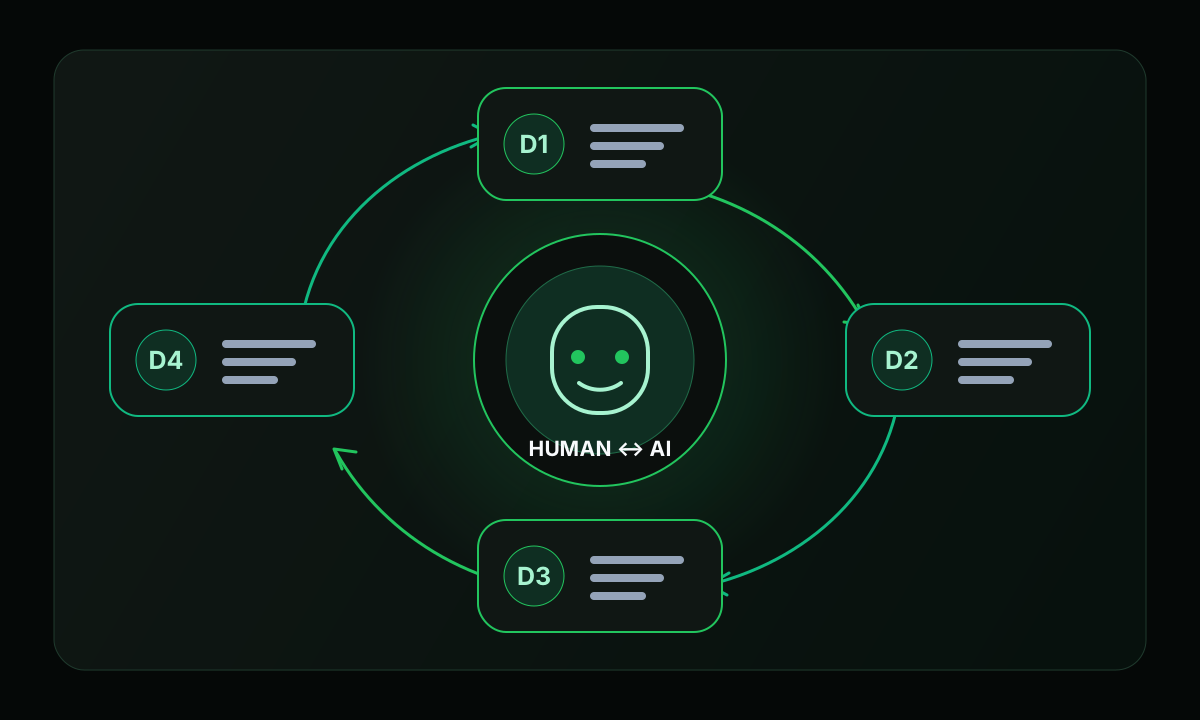
- Delegation: define the goal and decide whether, when, and how to use AI.
- Description: explain the context, intent, constraints, and expected result.
- Discernment: evaluate the usefulness, quality, and limitations of what was produced.
- Diligence: take responsibility, verify the work, and be transparent about AI use.
These competencies form a cycle. First, the person decides what makes sense to delegate. Then they guide the AI, evaluate the result, and take responsibility for what will be used or shared.
Anthropic says it uses this framework when onboarding its own employees. That does not make the method a universal rule, but it shows that the idea was not designed only as product documentation.
How it can help different people
- Beginners can replace fragmented learning with a sequence that starts with fundamentals and advances by goal.
- Professionals can turn isolated experiments into a process with context, quality criteria, and verification.
- Students and educators get paths that bring critical thinking, authorship, and transparency into the conversation.
- Developers can connect Claude Code, the API, MCP, skills, subagents, tool use, RAG, and agents.
- Teams can build shared language around limits, review, and responsibility.
Why discernment deserves attention
A 2026 study published by Anthropic found an important pattern. Conversations where AI acted as a thinking partner showed more behaviors associated with AI fluency than quick interactions. At the same time, when AI produced artifacts such as documents, code, or applications, users showed fewer critical-questioning behaviors.
The study does not prove that taking a course solves this problem. But it helps explain why learning to evaluate an output is as important as learning to request it. When a result arrives polished, coherent, and visually convincing, it is easy to mistake finish for correctness.
A simple path to get started
- Claude 101, to understand the interface, projects, artifacts, skills, and connected tools.
- AI Capabilities and Limitations, to build a mental model of knowledge, context, prediction, and failure modes.
- AI Fluency: Framework & Foundations, to practice delegation, description, discernment, and diligence.
- Claude Code 101, if your goal is related to software development.
- Claude Platform 101 or Introduction to Model Context Protocol, if you plan to build integrations.
This order is not mandatory. It simply avoids starting with agents and automation before understanding what should be delegated, how the model can fail, and how the result will be verified.
What the badge proves — and what it does not
A badge can document a learning path and signal interest in the subject. But it does not prove production experience, system architecture skills, or complete mastery of the tool. It should be understood for what it is: a verifiable record of completion.
Limits worth considering
- Claude Academy is created by the company behind Claude; some content is general, while some presents products and practices from its own ecosystem.
- Free access refers to the Academy. Claude, the API, Amazon Bedrock, and Vertex AI remain subject to their own product limits and pricing.
- The pages I checked were displayed in English; localization should be checked again in future updates.
- The catalog changes quickly, so course counts, names, and durations need to be rechecked.
- Completing courses does not replace applying the concepts, reviewing results, and building practical experience.
Closing thoughts
Claude Academy looks useful as a starting point because it organizes a path that is usually scattered across documentation, trial and error, and third-party content.
Its most interesting contribution, however, is not teaching everything that can be automated. It is reminding us that AI fluency also means recognizing what should not be delegated, evaluating what was produced, and remaining responsible for the final decision.
Learning AI is not only about discovering how much work a tool can perform. It is about developing the judgment to decide which work should remain with us.