
A practical RAG guide for developers
Understand RAG in practical terms: when to use it, when to avoid it, how the basic flow works, and which common mistakes hurt LLM applications.
RAG is not simply putting a PDF inside a chatbot. It is an architecture decision for retrieving useful context, giving that context to the model, and validating whether the answer became better, more verifiable, and more appropriate for the problem.
Context
RAG has become one of those acronyms that shows up quickly when someone starts studying AI applications. At some point, the conversation moves from "how do I call a model API?" to a more practical question: how can the application answer based on information that is not part of the model general knowledge?
It can be technical documentation, an internal knowledge base, a set of frequently asked questions, project notes, articles, support records, or any content that needs to be consulted before the answer.
RAG means Retrieval-Augmented Generation. The idea is to combine two parts: retrieve relevant information from an external base and use that information as context for the model to generate an answer.
The problem
The first explanation of RAG is often too simple: "just put your documents in a vector database and ask the chatbot." That sentence points to part of the flow, but it hides almost everything that determines whether the result will be useful.
- Are the documents good?
- Was the content split into useful pieces?
- Does retrieval bring back relevant context?
- Does the prompt know how to use that context?
- Does the answer show where the information came from?
- Is there validation when the answer looks correct but is not well grounded?
Without these questions, RAG can become an extra layer of complexity that only gives a more technical appearance to a poorly defined problem.
When RAG helps
A more practical way to think about RAG is to start with the problem, not the architecture. Before talking about embeddings, vector databases, or frameworks, it is worth asking: does the model need to answer using a specific knowledge base?
If the answer is no, RAG may not be necessary. Sometimes the problem is simply writing a better prompt, structuring the input, validating the output, creating a clearer screen, or solving a business rule in traditional code.
- Domain-specific information.
- Content that changes over time.
- Data that is not guaranteed to be in the model knowledge.
- Answers that need to be cited, checked, or traced.
- Documentation or knowledge bases too large to fit manually into the prompt.
RAG increases the chance that the answer relies on the right content. More chance, not a guarantee.
When RAG may be too much
- The necessary content is small and fits directly in the prompt.
- The answer depends more on business rules than text retrieval.
- The document base is disorganized or outdated.
- There is no criterion for evaluating whether the answer improved.
- The problem is still unclear.
- A simple traditional search would solve it better.
Not every question needs semantic search. Not every search needs an LLM. Not every LLM needs RAG.
A minimum flow
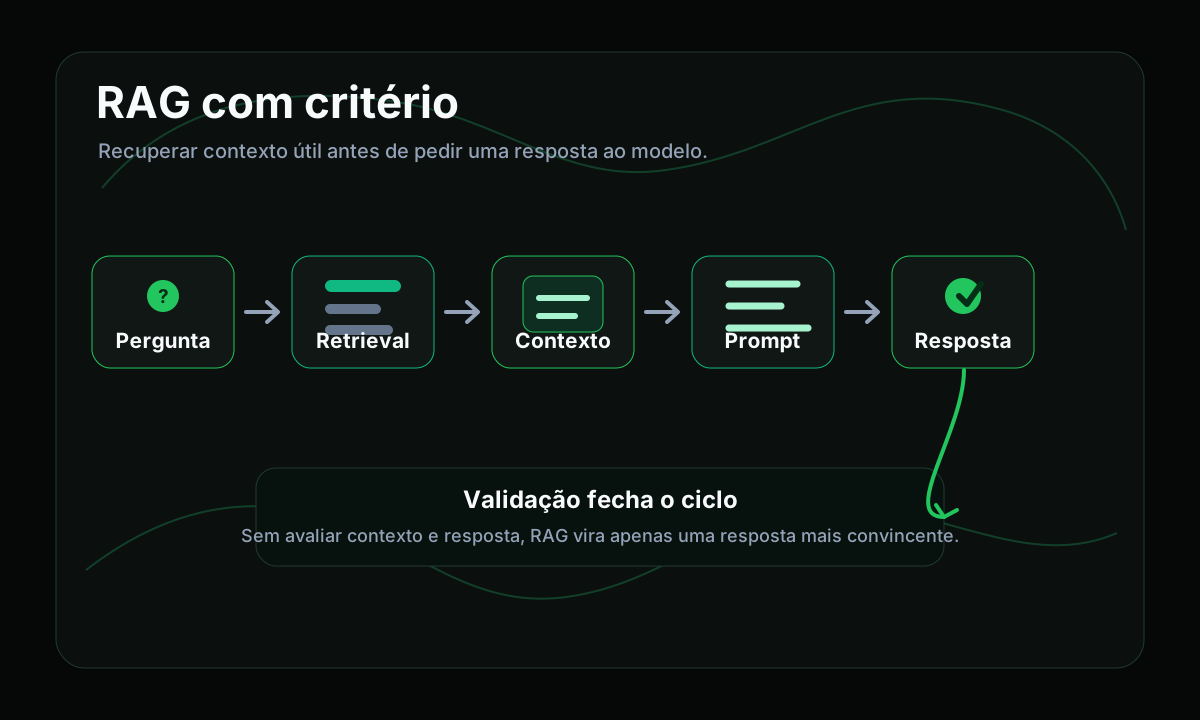
Imagine a fictional system for questions about product documentation. The person asks: "how do I configure access for a new user?" A RAG flow could receive the question, retrieve related passages, assemble a prompt with that context, and ask the model for an answer based only on the retrieved material.
1User question2 -> search the knowledge base3 -> retrieved passages4 -> context in the prompt5 -> model answer6 -> validation and displayThis flow looks simple, but each step can fail. If the documents are bad, the system retrieves bad context. If chunks are too large, retrieval may bring mixed information. If they are too small, the answer may lose context.
Common mistakes
Treating RAG as a synonym for chatbot with PDF
A PDF can be a data source, but RAG is not the PDF. RAG is the process of retrieving useful parts of that content and using those parts to generate an answer.
Thinking semantic search solves everything
Semantic search helps find passages related by meaning, but "related" is not the same as "sufficient to answer." In many cases, retrieval needs to combine semantics, filters, metadata, ranking, and simple rules.
Ignoring chunking
Chunking is how content is split before being indexed. If the content split is poor, retrieval also tends to be poor. This topic deserves its own guide, but the main point already matters: the split needs to preserve meaning, not only fit a size.
Not validating answers
If the application uses RAG, the natural question is: how do I know it improved? Without validation, the change may look good only because the answer became longer or more confident.
How to validate whether RAG is helping
A simple start is to create a small set of known questions: questions the documentation clearly answers, questions that require combining two passages, questions that look related but have no answer in the base, and out-of-scope questions.
- Which passages were retrieved?
- Were the passages sufficient?
- Was the answer faithful to the context?
- Could the system say it did not find enough information?
- Would the answer be useful to a real person?
This is still not a full eval process, but it already moves the analysis away from "it looks good." RAG without validation becomes a feeling.
Lessons learned
- RAG connects LLMs to external context, but it does not guarantee a correct answer.
- Quality depends on the knowledge base as much as on the model.
- Poor retrieval can make the answer worse, even with a strong model.
- Chunking, metadata, filters, prompt, and interface affect the final experience.
- For small problems, a simpler solution may be better.
- Validating known questions helps separate real improvement from a merely more convincing answer.
Limits and caveats
This guide does not try to teach a complete RAG implementation. It also does not choose a vector database, framework, model provider, or specific library. Those decisions depend on application type, data volume, update needs, cost, latency, security, and expected experience.
Before choosing a tool, it is worth understanding whether the problem calls for RAG, what context needs to be retrieved, how that context will be used, and how the result will be validated.
Conclusion
RAG is a very useful technique when an application needs to answer based on external context. But it is not a quality button.
What makes the difference is the whole flow: organized data, relevant retrieval, well-used context, answers limited to what was found, and constant validation.
For developers, the best way to start may be to treat RAG as an architecture question: does my application need to retrieve external knowledge before answering?