
A practical guide to OpenClaw, Hermes Agent, and personal agents
Understand what OpenClaw and Hermes Agent are, which benefits AI personal agents can bring, and which technical safeguards should come before autonomy.
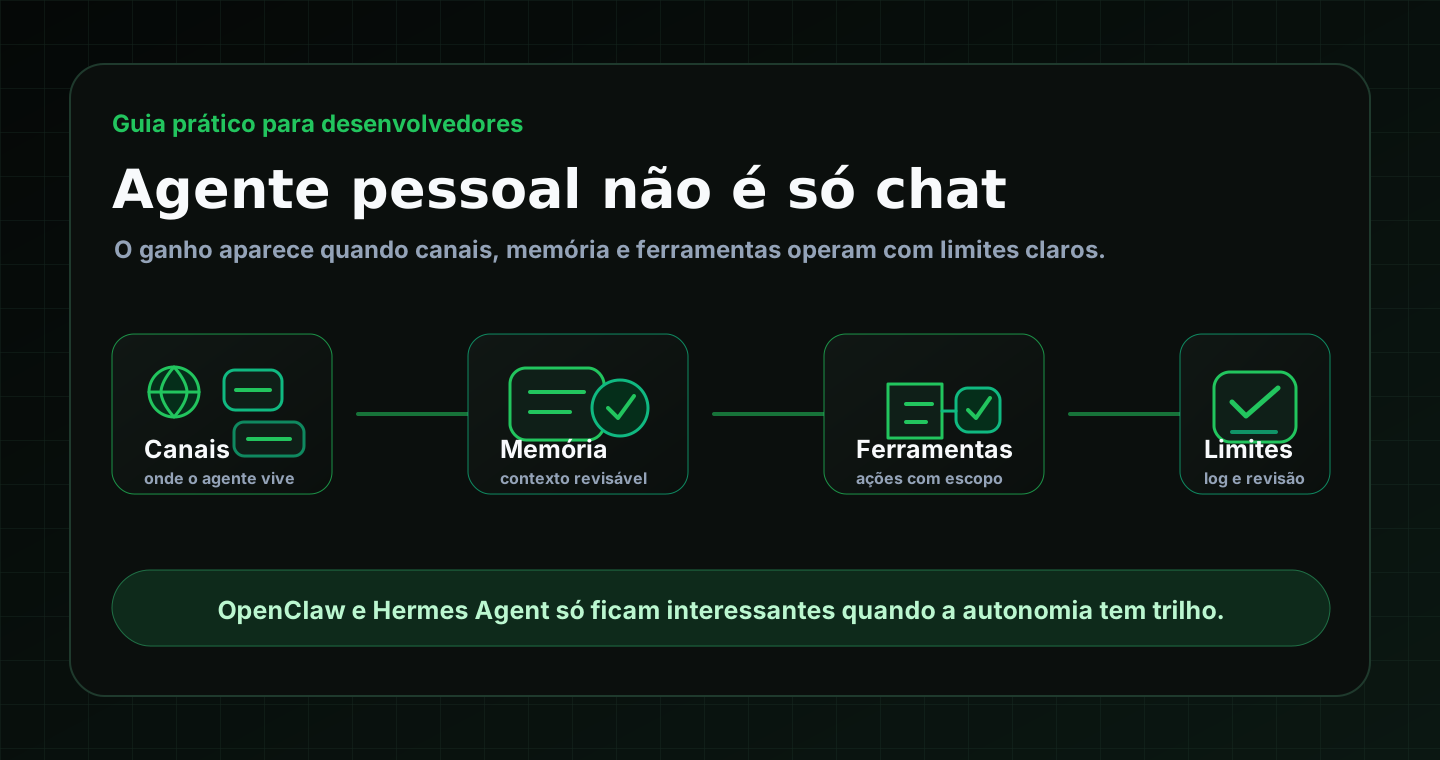
OpenClaw and Hermes Agent show that AI personal agents are not just smarter chats. They connect channels, memory, and tools, but only make sense when autonomy comes with permissions, logs, and human review.
Context
In the latest guides in this series, the conversation moved away from loose AI usage and closer to engineering: RAG for retrieving context, structured outputs for turning responses into data, evals for measuring behavior, harnesses for repeating tests, and agents with tools for consulting, deciding, or acting within a limited scope.
OpenClaw and Hermes Agent bring that discussion into a concrete space. The question is no longer only "when does a chatbot become an agent?" It becomes: what changes when that agent is available across channels, keeps memory, uses tools, and can handle small routines over time?
The problem
The risk when talking about personal agents is falling into two extremes. On one side, treating everything as magic: "AI will handle it all." On the other, dismissing the idea because it sounds too much like hype. Neither helps much if the goal is to understand the pattern with judgment.
The practical question is simpler: is there a recurring task where it makes sense to have an agent available, with context, limited tools, and the ability to prepare or execute controlled actions?
1chatbot2 -> answers when you ask34agent with tools5 -> consults, decides, or acts within a limited scope67persistent personal agent8 -> lives across channels, keeps context, and coordinates small routinesWhat OpenClaw is
OpenClaw is an open source, self-hosted gateway for AI agents. The idea is to run a gateway on your machine or on a server and connect that gateway to channels such as Discord, Google Chat, iMessage, Matrix, Microsoft Teams, Signal, Slack, Telegram, WhatsApp, Zalo, and others.
In practice, this changes the agent interface. Instead of opening a specific tab to talk to AI, you can call the assistant from channels that are already part of your day. OpenClaw works with a gateway, channel plugins, WebChat, sessions, tools, skills, automations, and memory.
The important point: OpenClaw should not be read as "just another chat." It is an infrastructure piece for connecting messages, models, tools, and routines. That gives flexibility, but also increases configuration and security responsibility.
What Hermes Agent is
Hermes Agent is an agent built by Nous Research. The official documentation describes it as an autonomous agent that improves with use, creates skills from experience, keeps memory across sessions, and can run in different environments, from a local machine to a VPS, Docker, SSH, Daytona, Singularity, or Modal.
It also has interfaces and gateways for channels such as CLI, Telegram, Discord, Slack, WhatsApp, Signal, Matrix, Mattermost, email, SMS, Microsoft Teams, Google Chat, and others. The documentation also highlights tools, toolsets, persistent memory, a skills system, MCP, scheduled automations, voice, sandboxing, and Nous Portal integration.
The narrative difference is interesting: while OpenClaw presents itself strongly as a gateway for agents across channels, Hermes Agent emphasizes continuous learning, skills, memory, and execution across multiple environments. In both cases, the real topic for developers is not "which one looks more powerful," but how to control what the agent can remember, call, and execute.
Practical benefits
- Less friction: the agent can be called from channels you already use.
- More continuity: sessions, memory, and context help with tasks that do not fit in one isolated question.
- More integration: tools and skills connect the agent to real actions.
- More routine: scheduled automations can prepare reports, reminders, and summaries.
- More control: self-hosted projects let you tune environment, permissions, models, and logs.
For developers, the healthiest use starts with low-risk tasks: organizing notes, preparing checklists, summarizing study context, drafting outlines, separating next steps, or retrieving decisions from a previous session.
Where the risk lives
Risk grows when channels, memory, tools, and permissions meet. A regular chatbot may give a wrong answer. An agent with a tool may perform a wrong action. A persistent agent may carry bad context from one interaction to another.
- Prompt injection in pages, files, messages, or results the agent reads.
- Permissions that are too broad for commands, files, accounts, or channels.
- Third-party skills and plugins with bad or unsafe behavior.
- Persistent memory storing incorrect, sensitive, or contaminated information.
- Insufficient logs to understand which tool was called and with which parameters.
- Scheduled automation repeating an error without human review.
Self-hosted does not automatically mean secure. It means you gained more control and also more responsibility.
How to test with judgment
I would not start by connecting a main email account, real calendar, sensitive files, and unrestricted shell access. I would start with a small, reversible, observable task.
11. read and organize22. suggest next action33. prepare draft44. ask for confirmation55. execute limited actionA safe example would be using the agent to turn notes sent through Telegram into a study outline or checklist. It does not publish, send messages to third parties, or alter important files. It only organizes context for review.
When not to use it
- When you only need occasional answers.
- When the task does not repeat.
- When the flow is deterministic and a simple function solves it.
- When you still do not know which permissions the agent needs.
- When the first idea is connecting important accounts before understanding logs and sandboxing.
- When the action is too sensitive to automate.
Lessons learned
- OpenClaw is best understood as a self-hosted gateway for agents across messaging channels.
- Hermes Agent emphasizes memory, skills, tools, execution across environments, and learning during use.
- The benefit is reducing friction in recurring routines, not handing over total autonomy.
- The more tools the agent accesses, the more important permissions, logs, and human review become.
- Prompt injection can also come from content the agent reads, not only from whoever talks to it.
- The first test should be small, isolated, reversible, and low impact.
Conclusion
OpenClaw and Hermes Agent are interesting because they point to a direction: AI leaving the chat-tab-only experience and moving closer to a persistent work layer.
But the mature question is not "which agent looks more autonomous?" The better question is: which task can I delegate with enough context, control, and review to trust the flow?
Useful autonomy starts small, observable, and reversible. If the agent proves value in that space, then it makes sense to expand the scope.