
AI routers in practice: how to choose models and use fewer tokens
Learn how an AI router selects models by demand, applies fallbacks, and balances quality, latency, tokens, risk, and total cost.
A useful router does not automatically select the cheapest model. It selects the simplest path that still satisfies the task contract.
Using the same model for everything is also a decision
Many AI features start with the simplest possible setup: one endpoint, one model, and one configuration for every request. That is a good choice while the goal is to learn. It reduces variables, makes debugging easier, and creates a baseline.
The problem begins when very different tasks keep going through the same route. Classifying intent, extracting fields from a document, answering from retrieved context, reviewing a diff, and planning a broad change do not necessarily require the same capability.
Some operations require vision, tools, or structured output. Others carry more risk or must follow a specific data policy. Simple tasks may not justify the same latency and cost as a difficult investigation.
An AI router turns those differences into policy. It receives signals about the demand, removes incompatible paths, selects an eligible option, and records why that decision was made. If execution fails or misses the minimum quality threshold, it may also trigger a controlled fallback.
What an AI router is — and what it is not
The term AI router is used for different architectures. Keeping these decisions separate prevents one confusing layer from doing everything without explaining anything.
- Model routing: which capability profile can satisfy this task?
- Provider or deployment routing: which compatible endpoint is healthy, available, or within its limit?
- Workflow routing: which chain, tool, or specialized agent should handle this demand?
- Context management: which instructions, files, retrieved passages, and results enter the call?
- Fallback: what happens when the primary route fails or misses a threshold?
A load balancer may distribute calls across two deployments of the same model without understanding the task. A gateway may centralize authentication, limits, logs, and cost without selecting capability by semantics. A fixed fallback may switch endpoints after an error without performing intelligent classification.
Current implementations make that difference clear. Amazon Bedrock predicts quality to route among compatible models. Cloudflare AI Gateway describes versioned flows with conditions, limits, and fallbacks. LiteLLM also uses router for deployment-level balancing by weight, latency, rate limits, or cost. No definition is universal; before selecting a tool, define which decision the system actually needs to automate.
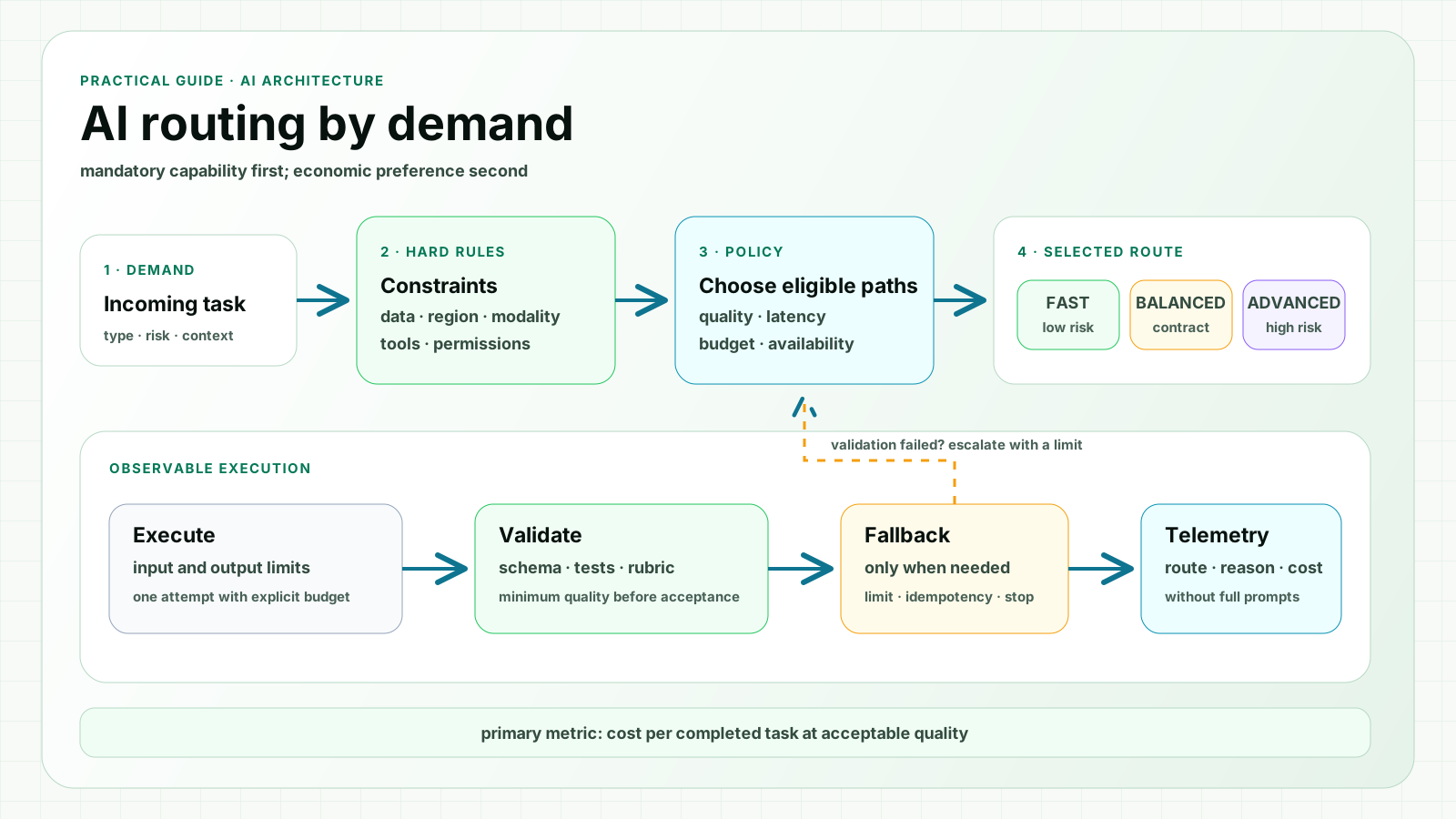
A minimum policy before adding intelligence
- Hard constraints: data, region, modality, tools, and permissions.
- Eligibility: which routes can satisfy the technical contract.
- Preference: among eligible routes, which one best serves cost, latency, or capability goals.
- Validation: how to determine whether output meets schema and minimum quality requirements.
- Fallback: when to try another route, request review, or stop.
- Telemetry: which route was selected, why, and with what result.
- Reevaluation: when to compare the policy with the baseline again.
Security and compatibility come before optimization. A task with an image cannot use a text-only route. A workflow that calls tools requires the same tool-calling contract. A region constraint must not depend on a probabilistic classifier.
1type Route = 'fast' | 'balanced' | 'advanced'23type Demand = {4 modality: 'text' | 'image'5 risk: 'low' | 'high'6 needsTools: boolean7 estimatedContextTokens: number8 previousValidationFailed: boolean9}1011function chooseRoute(demand: Demand): Route {12 if (demand.modality === 'image' || demand.needsTools) return 'balanced'13 if (demand.risk === 'high' || demand.previousValidationFailed) return 'advanced'14 if (demand.estimatedContextTokens < 8_000) return 'fast'15 return 'balanced'16}This pseudocode is not a production-ready policy. It demonstrates the decision order: mandatory capability first, economic preference second. It also treats a route as a stable profile instead of spreading model names throughout the product.
Deterministic, learned, and observed signals
Not every signal needs AI. Known metadata is often the best starting point: operation type, modality, tools, schema, estimated context, region, budget, sensitivity, criticality, availability, and rate limits.
When input is open-ended, a lightweight classifier may estimate intent, domain, or difficulty. This expands coverage, but it also adds another call, more latency, and another failure mode. The classifier may consume the savings routing was expected to create.
Hard rules handle security and compatibility. Classification applies only to the remaining space. After execution, validation, cost, and review show whether the policy worked.
Example 1: AI consumption inside a system
Imagine a fictional platform that classifies messages, extracts fields from documents, and generates answers for ambiguous cases. The alternative to one route can begin with three profiles and simple rules, without machine learning.
- Simple classification: text, low risk, fast route, allowed-category validation, and balanced fallback.
- Document extraction: image, schema, balanced multimodal route, JSON validation, and field rules.
- Ambiguous case: larger context or high risk, advanced route, evidence-based rubric, and possible human review.
The single route and hybrid policy need the same test set. If the fast route fails above the acceptable threshold, saying it saved tokens is not enough. If extraction returns valid JSON while swapping critical fields, schema validation alone does not represent success either.
1{2 "policy_version": "router-v3",3 "task_type": "document_extraction",4 "route": "balanced_multimodal",5 "reason_codes": ["requires_vision", "structured_output"],6 "input_tokens": 4280,7 "output_tokens": 312,8 "latency_ms": 1840,9 "validation": "passed",10 "fallback_count": 011}Telemetry records the decision without storing the full prompt. The system can explain route, reason, tokens, latency, and validation without indiscriminately copying documents, code, or personal data.
Example 2: AI-assisted development
A coding agent performs stages with different profiles: locating files, summarizing output, planning a change, making an edit, investigating a failure, running tests, and reviewing a higher-risk change.
Search and triage may use a fast route. Planning across multiple constraints or investigating repeated failures may justify a more capable route. A final security review may use different criteria from initial generation.
Changing models does not repair a poorly designed harness. The agent still needs correct repository access, relevant context, tools, permissions, tests, and stopping criteria. If it sends too many files, repeats logs, or loops, the router merely chooses who will process the waste.
- Stage type, language, and framework.
- Number of files, diff size, and risk.
- Terminal or other tool requirements.
- Previous validation failures.
- Criticality of the affected area.
Routing must also preserve continuity. Switching provider or model halfway through a task may reduce cache reuse, change tool behavior, and require context adaptation. Savings in one isolated stage may disappear in the cost of the complete trajectory.
A router helps spend better; it does not reduce tokens by itself
The router can decide which profile processes each stage, when to escalate capability, how many attempts are allowed, and which input, output, or reasoning limits apply to each route. It can also choose among direct calls, batch, asynchronous execution, or specialized workflows.
- It does not fix excessive or poorly selected context.
- It does not remove repeated tool results.
- It does not reuse cache automatically when prefixes change.
- It does not limit long answers without an output policy.
- It does not stop loops without stopping criteria.
- It does not avoid retries caused by low quality.
- It does not replace idempotency for side-effecting calls.
Context management, prompt caching, output limits, and workflow design remain separate controls. Stable prefixes can reduce processing and cached-input cost, but choosing another model does not automatically make context smaller or reusable.
A try-the-cheap-route-and-escalate strategy may execute two calls for every difficult case. If the first attempt rarely passes validation, the system increases tokens and latency instead of saving them.
1total task cost =2 router decision3 + primary execution4 + validation5 + retries6 + fallbacks7 + required human reviewThe most useful metric is cost per accepted task, not price per token or the percentage of calls sent to a smaller route.
Fallback cannot mean retrying without a limit
Fallback supports availability and controlled degradation. It can also duplicate work, hide incidents, and repeat operations with side effects. Before trying another route, the system needs to distinguish transient errors from deterministic failures and verify compatibility, idempotency, and time and attempt budgets.
A rate-limit failure may justify another deployment. An incompatible schema may require another capability or a corrected request. A policy violation must not be automatically bypassed through another provider. Router retries and internal SDK retries also need one clear owner to avoid multiplying calls.
What to measure to know whether the policy works
- Quality by criterion and completion rate.
- Cost per completed task.
- Total latency and percentiles.
- Tokens used by the router and selected route.
- Retry and fallback frequency and cost.
- Routing error by demand type.
- Human-review rate and availability by route.
- Schema or tool-contract violations.
The comparison should begin with a single route, move to deterministic rules, and only then test a hybrid strategy if necessary. Results need to be segmented by task, including the cost and impact of the router’s own mistakes.
Evals become an operational contract: describe the task, run representative inputs, and analyze the results to iterate. The set should cover common and boundary cases, including sensitive data, large context, tool failure, and unavailability.
When keeping one route is more mature
- One model handles the relevant tasks within budget.
- Volume is still low or the demand distribution is unknown.
- There are no evals or quality criteria.
- The system does not record cost and latency per task.
- Candidate routes are incompatible in format, tools, or data policy.
- The team cannot yet explain and operate the policy.
Adding a classifier, multiple providers, fallbacks, and telemetry before understanding the problem creates complexity without evidence of return. An observable single route is better than a sophisticated router nobody can validate.
A small, reversible experiment
- Choose one repeated task family with enough volume and a known success criterion.
- Record quality, latency, tokens, cost, retries, and review for the current route.
- Define only two compatible routes: one reference and one simpler alternative.
- Start with deterministic rules; classify only meaningful ambiguities.
- Validate before fallback, limit attempts, and protect side effects with idempotency.
- Run in shadow mode or on a small sample, with versioned policy and simple rollback.
- Decide by quality and cost of the completed task, not by isolated call.
Practical checklist
- The task and success criterion are defined.
- There is a single-route baseline.
- Security, region, modality, and permissions are explicit constraints.
- Every eligible route satisfies schema and tool contracts.
- Classifier, validation, and fallback costs are included.
- Retries have a limit and a single owner.
- Side-effecting operations are idempotent or protected.
- Decision reasons are recorded without excessive sensitive content.
- The policy has a version, gradual rollout, and rollback.
- Evals cover common, boundary, and failure cases.
- The comparison uses cost per completed task.
- Models, prices, limits, and task distribution will be reviewed periodically.
Limits and caveats
Available tools implement different slices of routing. Supported models, regions, prices, limits, and availability change. The examples in this article illustrate architectural differences; they are not vendor recommendations.
There is no universal difficulty signal. Prompt length, intent, or file count may help, but none replaces evals in the target domain. A classifier trained on old traffic may become stale as the product, models, or user behavior changes.
Fewer tokens do not necessarily mean lower total cost. Latency, error rate, operational engineering, human review, storage, observability, and incidents are also part of the decision.
Conclusion
An AI router is an operational policy, not an automatic savings machine. It helps when it makes explicit which paths satisfy the task, which signals change the decision, how output is validated, and what happens when the primary route fails.
The best starting point is not adding many models. It is building an observable single route, understanding the task distribution, and selecting one case where two capability profiles genuinely make sense. From there, use the simplest option that satisfies the contract, escalate deliberately, and measure the cost of the complete task.
Using fewer tokens may be a consequence. The objective is to spend capability where it changes the outcome.